
13-15 December 2024

New Cinema & Contemporary Art
An experience of hybrid film, art and performance
Friday 13 December 2024
EXHIBITIONS
Exhibitions | Contemporary Intersects
“Contemporary Intersects” explores different strata comprising our contemporary reality, or rather, questions the possible intersections between different ensembles, different spaces.
The starting point of the project is Gordon Matta-Clark’s monumental work “Office Baroque”, an intervention through the architecture of a building, of which only photographic and filmic traces remain today, which, while resonating with the Loods 6 building and its spaces, operates a radical transgression of our perception.
How can we speak of transgression, of transgressing, when it’s not a question of moral transgression? Rather, it’s a matter of crossing, or overflowing, what is posited as a boundary for our senses, for hearing and sight. It’s also, just as much, and perhaps more precisely, about fracturing. Of what fracturing – of what is not supposed to break – lets us hear or see.
Gordon Matta-Clarck‘s work literally cuts through a building, like an architect-sculptor, stripped of all the materiality that accompanies sculpture. The building is hollowed out, emptied, pierced along contours that seem at once governed by the most rigorous geometry, but also by the appearance of the most perfect arbitrariness, so that only a general view makes it possible to understand its purpose.
It’s a reversal of the act of seeing. Matta-Clarck acts; the work is the action. The film shows us an action whose result is no longer visible. The building has been destroyed.
As in “Conical Intersect” (1975), it is the act of seeing that transgresses, crosses and transforms the materiality of a building, reconnecting different spaces and scales. The act of seeing reveals something incomprehensible, if not monstrous, about our existence in the world: how is it possible for the unassignable interiority of an individual and the world that unfolds in complete exteriority to come together? Through our gaze, which reverses not only inside and outside, but also intimate private time and shared public time.
In “Office Baroque”, the gaze traverses’ space in unusual ways, ways that were previously impossible in the usual use of space. In this way, Matta-Clark transgresses the logic of the senses, exposing the monstrosity of the act of seeing, which brings together the invisible of the most intimate gaze with the exteriority of the world and its constructed spaces.
By projecting the shadow of vast foliage onto the ground, “Invisible Presence” literally opens up the space, abolishing the walls of the exhibition space. With Theis Wendt‘s installation, the transgression or reversal here is not that of up and down, but rather that of depth and surface.
What is evoked is not so much the shadow of foliage, but the trees and light that produce it, just as the thing precedes the word, presence exceeds representation. The installation creates a monumental off-screen space, on the scale of the world. The gap between the evoked presence and what is visible evokes a world of strange tones, a world buried or past, imbued with a strange nostalgia. With the slow quivering of leaf shadows, the entire surface of the world vibrates.
We’re in that part of the world: a world beyond our contemporary times, after our society has collapsed, there’s only invisible trees and sun, perceptible only through shadows.
Yet there is no hidden truth in the depths of the sky. In line with Deleuze’s reflection in “The Logic of Sense” that the search for the meaning of something ceases to be a search for its “deeper meaning”, hidden beneath visible appearances, here, through these projections, all depth is brought to the surface; there is no depth or invisibility outside what is present on the surface.
With his installation “Topia”, Zalán Szakács questions these notions by confronting us with the vision of immaterial screens interwoven through space, made perceptible by light and haze. What he questions are the very notions of surface and projection. The surfaces of the screens are themselves dissolved, no longer a material support stopping the light and allowing us to perceive projected images, they become images themselves and are the very finality of what is to be perceived, without opacity, constituted by light, now imbricated in the depth of space. The screens become thresholds, fractures of light, opening onto suspended spaces where perception wavers.
In “Under Boom”, Louis Braddock Clarke makes the fracturing of the world audible. His installation plunges us into the deep murmurs of the Earth, where the inaudible becomes vibration and time, resonance. From an island in the middle of the Atlantic, the distant sounds of the planet, captured and recorded as infrasound – air strikes, calving of ice sheets, seismic guns, etc. – are amplified and become the sonic signs of the disturbances and crises of our time. Sound becomes a trace inscribed in our disrupted ecosystems. The installation acts as a listening station, a sensitive point where the deep vibrations of the world and the traces of our history intertwine, thus opening up the possibility of a different kind of listening and a different experience of the world.
Each of the four works in the exhibition represents a transgression or reversal of our way of perceiving and understanding the world. Each work designates different spaces, crosses and transforms them, and, at their intersection, questions the possibility of a common world.
These four works connect us to the urgent and necessary nature of a common perception, at the intersection of the multiple contemporary spaces we cross.
EXHIBITIONS
Louis Braddock Clarke: Under Boom
Video installation, two screens, sound | colour | 00:18:00 | United Kingdom, Netherlands | 2024

EXHIBITIONS
Gordon Matta-Clark: Office Baroque
Exp. documentary, 16mm on HD, excerpt on videoprojection, entire work on flatscreen, sound | colour | 00:44:00 | USA, Belgium| 1977-2005
EXHIBITIONS
Zalán Szakács: Topia
Installation, GLP fusion sticks light fixtures, haze machine | Netherlands | 2024
EXHIBITIONS
Theis Wendt: Invisible Presence
3 channel video installation | Denmark | 2019-2024
VR PROGRAMME
VR Programme
The Rencontres Internationales in Amsterdam invites you to experience eleven works in virtual reality. Eleven experiences akin to traversing shifting landscapes, spaces that stretch and dissolve, narratives where time and matter vacillate. Gathered together under the title ‘Contemporary Intersects’, these works explore the fractures and recompositions of our perceptions, between private and collective spaces, intimate and political.
Walls tremble and shift, and time seems to fade away. The strata of space become scores. The links between individuals and spaces are loosened and recomposed, memories are rearranged in new combinations, revealing the unspoken aspects of social and emotional interactions.
Here, everything is recomposed: the links between bodies and places, promises and disillusions, the architecture of a museum transformed into a field of possibilities.
These works plunge into history, breaking down the common space and questioning the fragile foundations of our societies. They probe the promises of technology - a force for progress or an instrument of domination - capitalism, which commodifies young people reduced to data, and the denial of the passage of time.
Virtual reality spaces also take on a political and historical dimension, asking us questions about the over-exploitation of resources and the extinction of living beings, and about the human dignity that has been abused in the course of history.
From poisoned industrial soils to contemporary migrations re-enacting the tragedies of Sophocles, a loop is drawn, insistent and necessary. These works do not show: they question. They fragment and recompose space, exposing its political charge and its capacity to embody both the common and the intimate. They invite us to feel, to question and, perhaps, to invent new arrangements of reality.
VR PROGRAMME
Loukia Alavanou: On the Way to Colonus
VR 360 video | colour | 0:20:00 | Greece | 2021
VR PROGRAMME
Inti Gallardo, Lucian A. Meister: Mnemoc(y)ne
Experimental VR/XR | colour | Argentina, Chile, Spain | 2019
VR PROGRAMME
Nicolas Gebbe: Lockdown Dreamscape VR
VR 360 video | colour | 0:07:00 | Germany | 2021
VR PROGRAMME
M+M: Olympic Vertigo
VR 360 video | colour | 0:05:50 | Luxembourg, Germany | 2023
VR PROGRAMME
Lauren Moffatt: Image Technology Echoes
Experimental VR/XR | colour and b&w | Australia, Ireland, Germany | 2021
VR PROGRAMME
Doireann O'Malley: New Maps of Hyperspace
VR 360 video | colour | 0:06:44 | Ireland | 2020
VR PROGRAMME
Marlies Pöschl: Vivo Vision
VR 360 video | colour | 0:34:30 | Austria, Thailande | 2024
VR PROGRAMME
Chi Yin Sim: The Garden of No Return
VR 360 video | colour | 0:10:36 | Singapour | 2023
VR PROGRAMME
Matthijs Vuijk: With the Whole World Crumbling, We Pick This Time to Fall In Love
VR 360 video | colour | 0:07:00 | Netherlands, South Africa | 2021
VR PROGRAMME
Amy Louise Wilson and Francois Knoetze: The Subterranean Imprint Archive
Experimental VR/XR | colour | South Africa | 2021
VR PROGRAMME
Omid Zarei and Anne Jeppesen: A Vocal Landscape
Experimental VR/XR | colour | Denmark, France, Iran | 2023
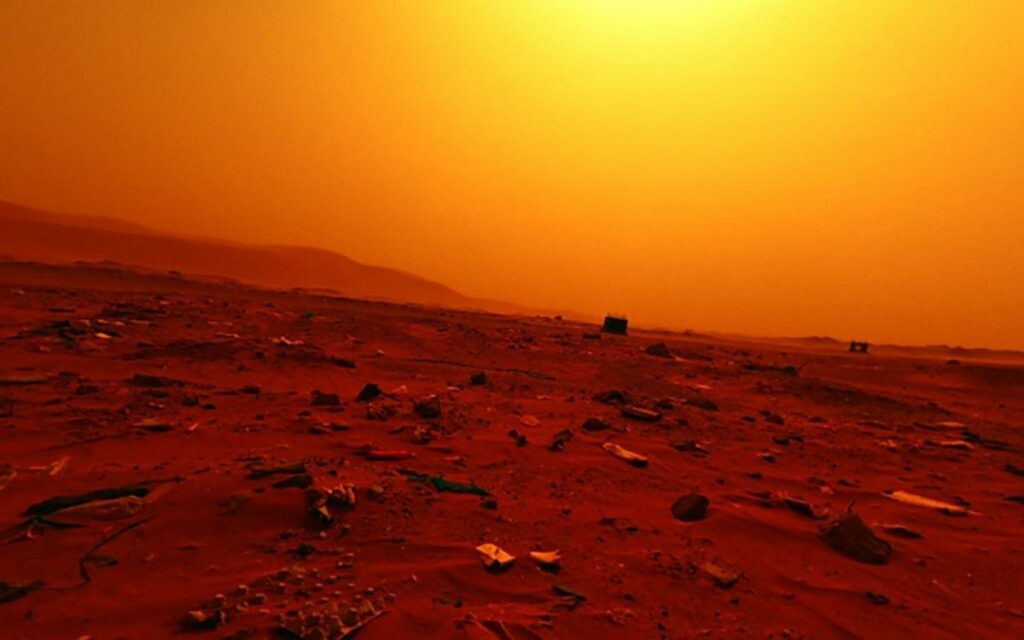
18:00 - 19:00 | Video in loop | “Memories of an Unborn Sun”
Memories of an Unborn Sun is an audiovisual installation in which documentary facts overlap with fiction, reflecting on the geopolitical impact of the extractive forces that transform our world. Based on rumours, fake news, and viral tweets, this narrative puzzle questions how algorithmically fed information is shaping our memory.
The climate crisis is affecting particularly Northern Africa in dire and far-reaching ways, amplifying long-standing problems, and sharpening socio-economic inequalities. One Big Economy of the Sun aims to articulate a metaphysical query around light as a form of memory. Illuminated by an artificial sun, this nightless world embodies the illusion of infinite growth. How to remember those made invisible? Exiled workers and ghosts of an energy quest.
VIDEO IN LOOP
Marcel Mrejen: Memories of an Unborn Sun
Video installation | 4k | colour | 0:22:00 | France, Algeria | 2024
19:00 | Screening | “The Black Sun”
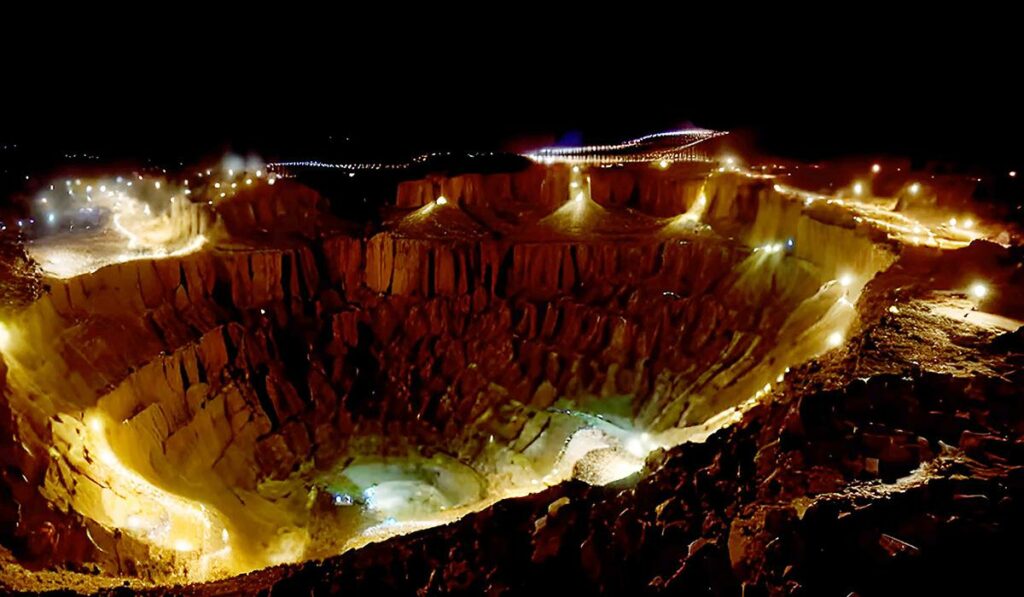
Emmanuel van der Auwera recreates a mine in Mongolia where rare earth minerals, a strategic resource essential to digital technologies, are extracted under dramatic human and environmental conditions. In a veiled metaphor, Peter Rose captures the instabilities of our time and the dangerous instability that characterises American politics today. Syd Farrington attempts to recapture the London skyline and, in an abstraction, combines the free-falling movements of recently built skyscrapers. In an associative montage, Clemens von Wedemeyer brings together infrastructures from the digital economy of contemporary California. Individuals are networked, but Silicon Valley companies are inaccessible, and public space is closed off by intelligent fences. Marco Douma and Roel Meelkop reveal a fascination for exploring the indescribable and the ambiguous, to propose an indefinable space, where space and time merge into each other, a space in which certainties disappear.
19:00 | SCREENING |“The Black Sun”
Emmanuel van der Auwera: White Cloud
Exp. documentary | digital | colour | 0:19:00 | Belgium | 2024
19:00 | SCREENING |“The Black Sun”
Peter Rose: A Sign of the Times
Video | hdv | colour | 0:01:46 | USA | 2021
19:00 | SCREENING |“The Black Sun”
Syd Farrington: Descent
Exp. film | 16mm | colour | 0:06:00 | United Kingdom | 2023
19:00 | SCREENING |“The Black Sun”
Clemens von Wedemeyer: Surface / Composition
Exp. documentary | Digital | colour | 0:22:00 | Germany, USA | 2023